Why Similar Pictures Belong Together in a Photo Album
Similar pictures in a photo album can reveal a scene’s rhythm. Learn how to arrange a short sequence so each frame carries the action forward.
How can similar pictures in a photo album make a moment feel as if it is still unfolding? Arrange them around a visible action, and the page can carry its pace: a hand reaching, a curtain lifting, a face turning toward a sound. The point is not to collect every frame, but to give a small movement room to happen.
Build a visual beat
Repetition creates a steady beat when something stays in place. A row of porch railings, a kitchen table, or a person’s coat can anchor the eye while a gesture changes from frame to frame. That stable detail lets the viewer notice the movement without having to reorient to an entirely new scene.
Think in terms of beats rather than a contest for the “best” photograph. A sequence might begin with a held pose, shift into action, and land on a reaction. Another might repeat a still composition while changing only the light. The rhythm can be quick and lively or quiet and lingering; what matters is that the frames relate in a way the viewer can see.
Follow the action
Look for a movement that has direction or duration: someone opening a gate, a dog settling beside a chair, or steam drifting from a mug. For each candidate, ask what it does to the flow. Does it set up the movement, carry it forward, pause it, or show its result? A frame can be visually similar to its neighbors and still earn its place if it changes the pace or emphasis.
Try arranging the pictures as a short visual phrase. A wider view can establish where the action happens; a closer view can make a small gesture more legible; a final frame can show what follows. This is not a rule that every sequence must zoom inward. A repeated viewpoint can be stronger when the action itself supplies the variation.
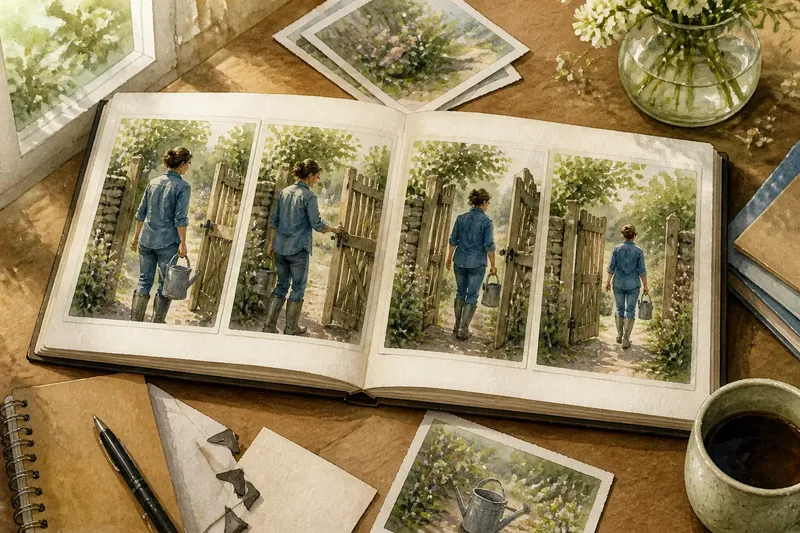
For example, imagine you have an invented set of photos of a friend opening a garden gate while carrying a watering can. Start with a frame showing the closed gate and the friend approaching, then place a frame with one hand on the latch, followed by one with the gate swinging open and a final view of the friend stepping through. The starting inputs are the repeated garden background and those four stages of action; arranging them in that order should make the movement across the page easy to follow. If the last frame instead shows the friend still outside, the sequence may feel paused rather than completed, which could be the more useful ending if the album turns to the garden on the next page.
Shape the page rhythm
Order changes the way a sequence feels. Chronological order is useful when it clarifies an action, but the emotional beat may suggest another arrangement: a quiet pause between lively frames, or a close detail saved for the end. Lay the candidates out as small thumbnails or place prints on a clean table, then swap neighboring images and notice where the movement feels smooth or abrupt.
Spacing is part of the rhythm, too. Keep related photographs close enough to register as a group, but leave room around them so the eye can pause. A larger image can establish the setting while smaller ones carry the successive beats. Equal-sized prints can work just as well when you want the action—not scale—to lead.
In a digital album, check the sequence by swiping through it at an unhurried pace. In a print album, view the whole page before studying individual faces. If the action reads without a caption explaining every transition, the layout is doing its job.
Check the rhythm?
How many similar photos should I use?
Use enough frames to make the action or pause visible, then stop when another image repeats the same beat. If the sequence still feels unresolved, consider whether a missing transition matters more than adding another near-identical view.
Should the sequence stay chronological?
Keep chronological order when it makes the action easier to follow. If another order creates a clearer pause or ending without confusing what happened, that arrangement may suit the page better.
What belongs between two action photos?
A quieter frame can work as a pause if it shares a visual anchor with the surrounding pictures. If it breaks the scene’s continuity, move it elsewhere or leave it out.
Can captions help the sequence?
Use a caption for context that the photographs cannot show, such as a place name or why the group gathered. If the words merely narrate a visible gesture, let the images carry that beat instead.
Keep useful alternatives
Before settling the layout, make a quick pass through these decisions. Each check connects an observable feature to a next action:
- Same setting: If the background stays steady, use it as the visual anchor; if it changes enough to distract, group the pictures by setting or choose a clearer transition.
- Action direction: If a person or object moves consistently across frames, order the pictures along that path; if the direction is unclear, try a wider establishing image first.
- Visible transition: If each chosen frame changes the action or pace, keep the run; if two adjacent frames show the same beat, remove one or separate them with a purposeful pause.
- Emotional landing: If the last picture gives the scene a satisfying pause or result, end there; if it feels unfinished, try an earlier reaction or a frame that shows what follows.
- Page breathing room: If the pictures are easy to read together, keep their spacing; if the group feels crowded, reduce the number of frames or give the sequence more page space.
- Caption need: If a detail such as the location or occasion would otherwise be lost, add a brief caption; if the text only repeats visible action, omit it.
A similar-picture sequence belongs in a photo album when its repetition makes the action easier to feel, not merely longer to view. Keep the original files or prints even if the finished page uses only a few; the album’s order is an arrangement for the reader, while the unselected frames remain part of the larger collection. When choosing among possible orders, remember that a page turn can serve as a pause, too.