From Loose Prints to the Photo Album
From loose prints to the photo album, trace how mounting, captions, and page order shaped a collection people could browse and understand together.
How did a stack of loose prints become a photo album that feels like a story? From loose prints to the photo album, the answer lies in a practical format: pages could hold images in view, keep chosen neighbors together, and leave space for notes. That description explains what an album does without claiming a single origin or a universal path from loose photographs to bound collections.
Pages and prints
A loose print can be passed around, but it may be separated from other images or from the note that identifies a person. An album gives photographs a shared container and lets its maker place images together deliberately. The page becomes part of the arrangement, not just a surface beneath the print.
Mounting choices shape how that arrangement can change. Photo corners can hold a print while leaving it removable; adhesive can make repositioning difficult and may harm a photograph. Modern albums may use sleeves instead. For older photographs, avoid pulling prints from pages or applying new adhesive. If preservation matters, consult a qualified photograph conservator about handling and storage.
Say you have a handful of family portraits and want to place them in an album. You sort the prints by people you can identify, use photo corners rather than sticking them down, and leave uncertain portraits apart until someone can help name them. The observable result is a browsable group whose identified relationships are visible without turning guesses into facts.
Captions and context
A photograph may show a face or a place clearly while leaving the names and circumstances unknown. A caption can preserve what the maker knows: a person’s name, a location, an occasion, or the source of the information. Keep observation separate from recollection. “Two people beside a red car” describes visible details; “Aunt Ruth and her neighbor after the fair” identifies people and an occasion only if those details are known.
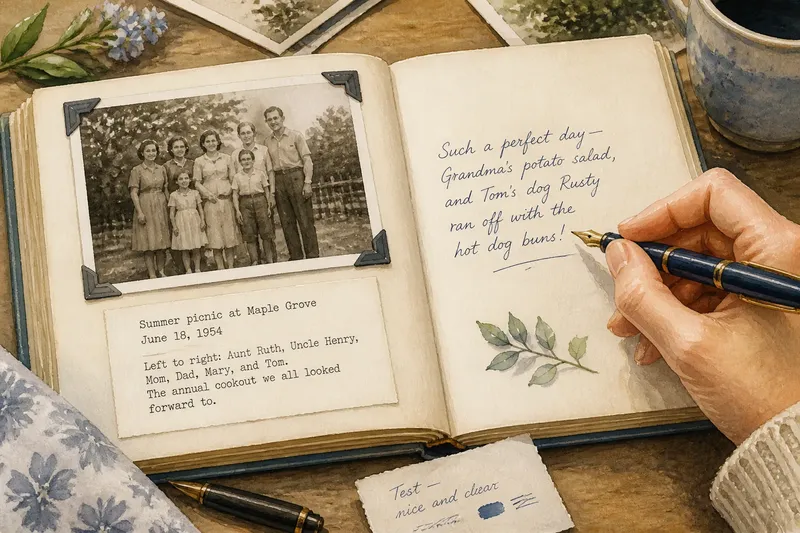
Write captions near the image, but not directly on a photograph unless a conservation professional advises it. Use a pencil on a suitable album page where appropriate, or place a separate, clearly associated note in a sleeve. Mark uncertain information plainly, such as “possibly Ruth,” and retain the original note if you are transcribing one. These habits help later readers distinguish a remembered detail from a firm identification.
Order and browsing
An album can follow dates, family branches, places, or occasions. No single order fits every collection. Chronology can make a sequence of events easier to follow; grouping by relatives can keep related portraits together; arranging by place may suit photographs made across different years. A short contents note can help readers understand the organizing choice.
For a small collection, first separate photographs with known context from those that need identification. Then choose one organizing principle for each section, and add captions only where the information is reliable or clearly marked as uncertain. The result should let a reader follow the chosen pattern without mistaking sequence for proof: adjacent images may belong together by design, not because they depict the same event.
What should an album maker consider?
Should photographs be glued into an album?
Adhesives can make prints hard to remove and may damage them, so photo corners or suitable sleeves are often more reversible options. For a fragile or valuable photograph, ask a photograph conservator before changing its mounting.
How should uncertain captions be written?
State the uncertainty directly, using wording such as “possibly,” “identified by family as,” or “date unknown.” Keep the source of the information when possible, so later readers can assess what is remembered and what remains unclear.
What order works best for family photographs?
Choose the order that answers a reader’s likely question, such as who is pictured, where the photographs were made, or how an occasion unfolded. If the dates are uncertain, organize by a better-supported feature rather than presenting a guessed chronology.
How can an album be shared safely?
Use clean, dry hands, support the binding, and turn pages gently without forcing them flat. If a page is brittle, a print is stuck, or the album shows signs of damage, pause and seek professional conservation advice rather than attempting a repair.
Choices that guide readers
- Observe: A print is loose and the album uses adhesive. If it is fragile or valuable, then leave it in place and ask a conservator; otherwise, consider a reversible photo corner for future mounting.
- Observe: A caption names a person, but no one knows who wrote it. If its source is unclear, then preserve the wording as an unattributed note; otherwise, record the identified source beside the transcription.
- Observe: Dates appear on only some prints. If the remaining dates cannot be supported, then avoid a strict chronological sequence; otherwise, label uncertain dates as estimates rather than facts.
- Observe: Several portraits show the same family branch. If relationships are known, then group them by branch and caption the connections; otherwise, keep them together as an unidentified group without assigning kinship.
- Observe: A page has little room for captions. If notes would crowd or cover the prints, then use a separate, clearly linked note; otherwise, write briefly on an appropriate page area.
- Observe: A page is brittle, stuck, or torn. If handling risks further damage, then stop and consult a photograph conservator; otherwise, turn the page gently while supporting the binding.
A worked arrangement
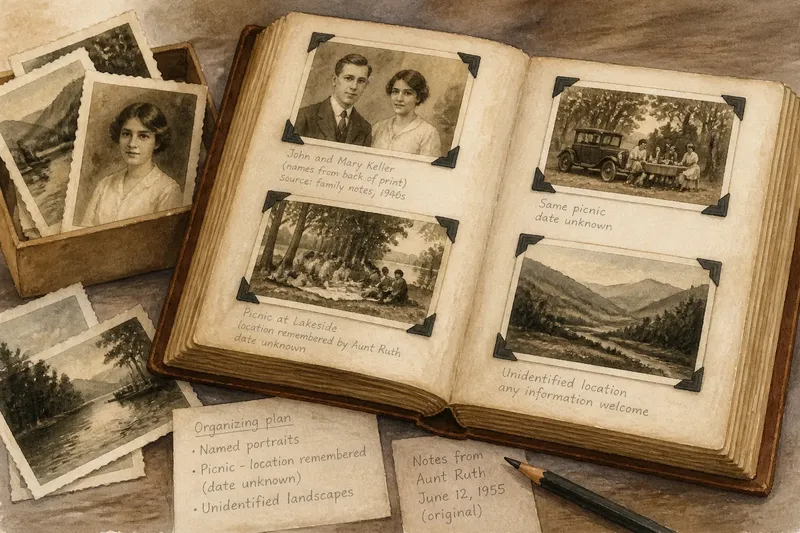
Imagine Maya has six loose family prints: two portraits with names written on the back, two pictures of a picnic whose location is remembered but whose date is not, and two unidentified landscapes. She wants relatives to browse them without confusing memory with certainty.
She first separates the portraits, picnic pictures, and landscapes. She puts the named portraits together and transcribes the names onto album pages beside them, noting that the names came from the backs of the prints. She places the picnic pictures in one section, captions the remembered location, and writes “date unknown” rather than guessing. She keeps the landscapes together at the end with a note that their locations are unidentified. The resulting album offers three clear groups, preserves the source of the names, and leaves open questions visible for relatives who may know more.
Form without a fixed story
An album makes selected relationships visible through pages, captions, and sequence, but it cannot supply missing context on its own. For anyone arranging an album today, the useful question is what a future reader can distinguish: what is visible, what is remembered, and what remains uncertain. That is how a collection can invite browsing while leaving room for new information.